
DeMorph: Morphing Devices Functioning via Sequential Degradation
Abstract: While it may initially seem counterintuitive to view degradation within an operating system as advantageous, one could argue that, when intentionally designed, the controlled breakdown of materials—whether physical, chemical, or biological—can be leveraged for specific functions. To apply this principle to the development of functional morphing devices, we have introduced the concept of "Degrade to Function" (DtF) [16]. This concept is aimed at creating eco-friendly and self-contained morphing devices that operate through a series of environmentally triggered degradations. In this demonstration, we elucidate the DtF design strategy and present five application examples across a range of ecosystems.
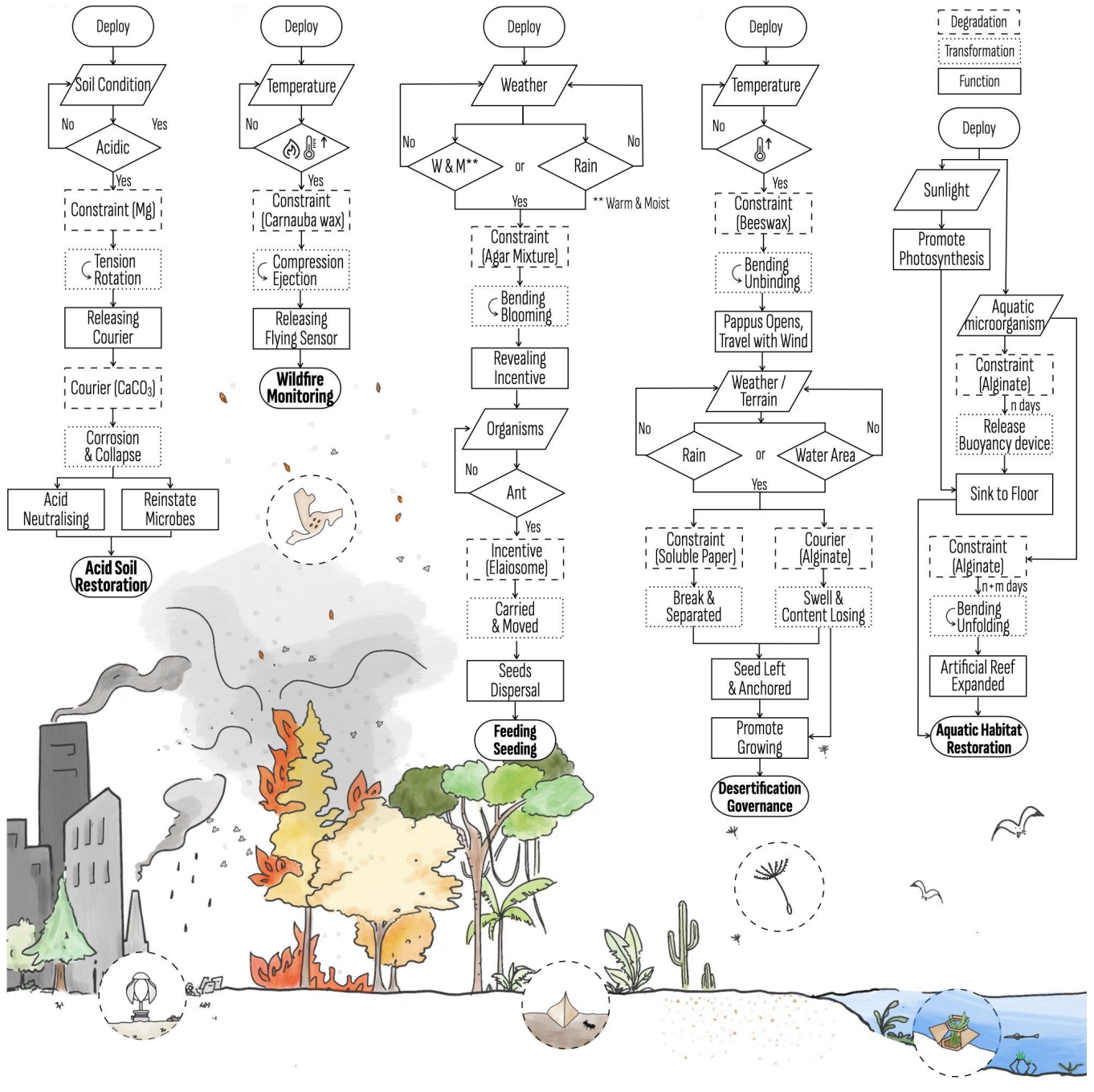
An overview of five examples of Degrade to Function applications across various ecosystems.