
Degrade to Function: Towards Eco-friendly Morphing Devices that Function Through Programmed Sequential Degradation.
Abstract: While it seems counterintuitive to think of degradation within an operating device as beneficial, one may argue that when rationally designed, the controlled breakdown of materials— physical, chemical, or biological—can be harnessed for specific functions. To apply this principle to the design of morphing devices, we introduce the concept of "Degrade to Function" (DtF). This concept aims to create eco-friendly and self-contained morphing devices that operate through a sequence of environmentally-triggered degradations. We explore its design considerations and implementation techniques by identifying environmental conditions and degradation types that can be exploited, evaluating potential materials capable of controlled degradation, suggesting designs for structures that can leverage degradation to achieve various transformations and functions, and developing sequential control approaches that integrate degradation triggers. To demonstrate the viability and versatility of this design strategy, we showcase several application examples across a range of environment conditions.
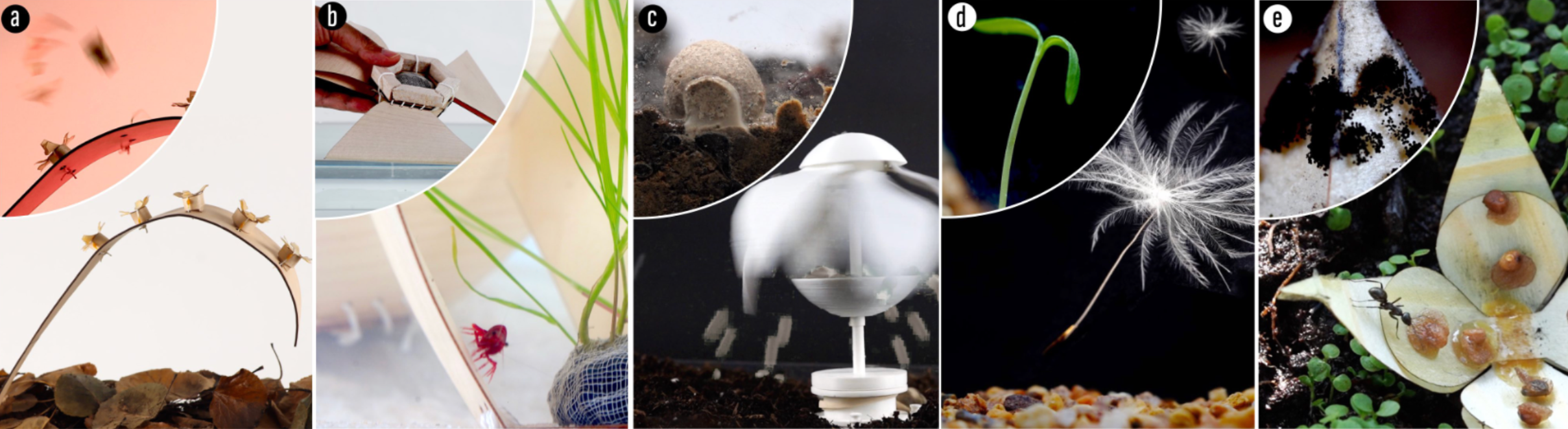
Presenting “Degrade to Function” examples: the self-sustaining wildfre monitor (a), aquatic shelter (b), acidic soilrestorer (c), desertifcation mediator (d), and forest seeder (e). Each is capable of functional sequential transformations, activatedby accelerated partial structure degradation in response to specifc environmental conditions.