
Enabling Generative Design Tools with Large Language Model Agents for Mechanical Computation Devices: A Case Study
Abstract: In the field of Human-Computer Interaction (HCI), interactive devices with embedded mechanical computation are gaining attention. The rise of these cutting-edge devices has created a need for specialized design tools that democratize the prototyping process. While current tools streamline prototyping through parametric design and simulation, they often come with a steep learning curve and may not fully support creative ideation. In this study, we use fluidic computation interfaces as a case study to explore how design tools for such devices can be augmented by Large Language Model agents (LLMs). Integrated with LLMs, the Generative Design Tool (GDT) better understands the capabilities and limitations of new technologies, proposes diverse and practical applications, and suggests designs that are technically and contextually appropriate. Additionally, it generates design parameters for visualizing results and producing fabrication-ready support files. This paper details the GDT's framework, implementation, and performance while addressing its potential and challenges.
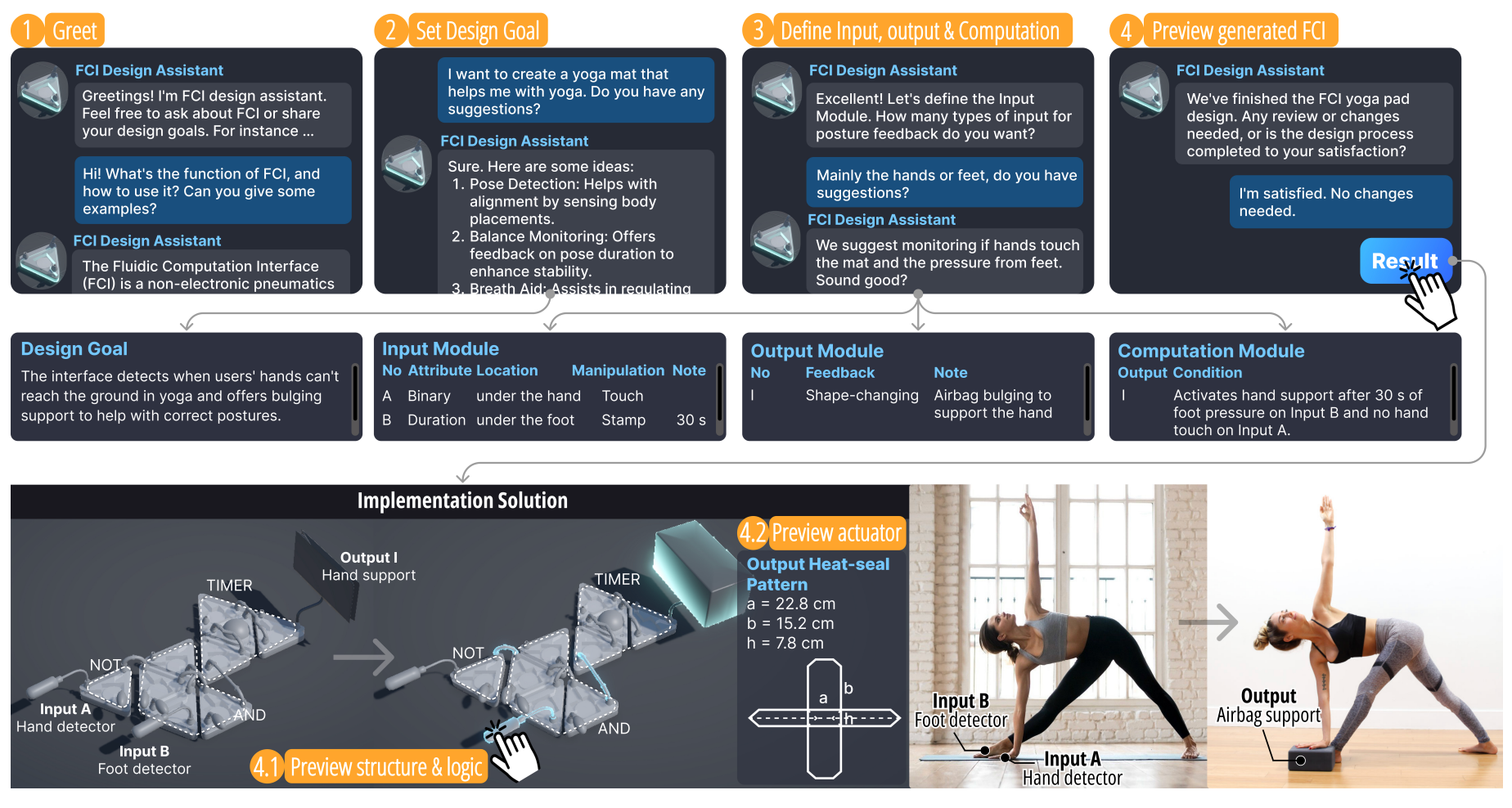
The user flow for designing with Fluid Computation GDT includes: (1) Greeting the Consultant and freely asking for explanations to learn about FCI. (2) Setting the design goal with the help of ideation. (3) Defining the input, output, and computation modules with the Consultant’s guidance and recommendations. (4) Confirming the design definition and previewing the generated fluid computation system; clicking the input module to see the animated demonstration of control logic.